Mining is the backbone of the Western Australian economy, and it runs on infrastructure that is buried, pressurised, and unforgiving when something goes wrong.
Underneath every mine site sits a dense network of power cables, communications lines, dewatering pipes, and tailings infrastructure. Strike one with a mechanical excavator and the cost is rarely just the repair. It is unplanned downtime, a safety incident, an environmental report, and a delay that ripples across the operation.
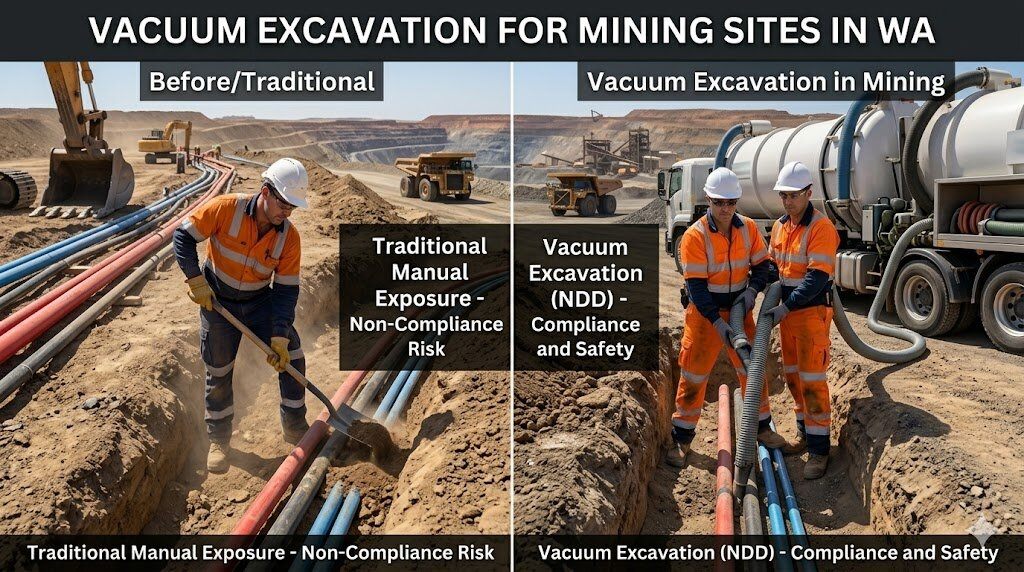
This is why vacuum excavation is now a standard tool on mine sites from the Pilbara to the Goldfields. It removes ground without the impact risk of a steel bucket, exposes underground assets safely, and handles the slurry, sludge, and spills that mining generates every day.
This guide explains how vacuum excavation supports WA mining sites, its main applications, the compliance picture, and what makes a contractor genuinely mine-ready.
What Is Vacuum Excavation?
Vacuum excavation, also known as non-destructive digging (NDD), is a method of removing soil and material without the impact risk of mechanical excavation.
A specialised vacuum truck uses high-pressure water or compressed air to loosen the ground, then lifts the material through a powerful suction hose into a sealed onboard tank. Because the ground is broken up gently rather than cut with a steel bucket, the method removes the biggest danger of digging near live infrastructure, the strike itself.
On a mine site, the same trucks do far more than dig. They also work as heavy-duty industrial vacuum units, extracting slurry, sludge, fines, and contaminated liquid from areas where manual clean-up would be slow or hazardous. This dual capability, precise digging and heavy industrial vacuuming, is what makes the technology so well matched to mining.
Why Mining Sites in WA Need Vacuum Excavation
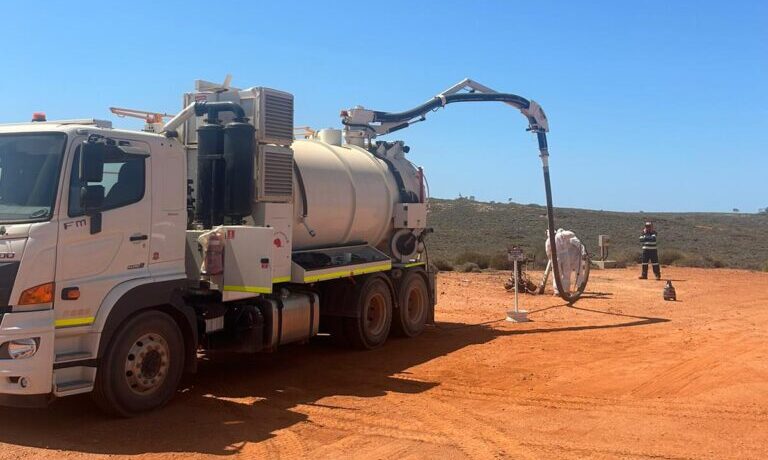
Western Australia is one of the most significant mining regions in the world, with iron ore in the Pilbara, gold and lithium across the Goldfields, and resource activity through the Mid West and beyond. These operations share a set of challenges vacuum excavation is well suited to solve.
The first is location. WA mine sites are typically remote, the terrain is rugged, and shifts are long, so equipment and crews must operate far from support without constant resupply.
The second is buried infrastructure. A working mine is crossed by power, communications, dewatering lines, and tailings pipelines, and as operations expand the chance of striking an existing asset only increases. Exposing those services without damage is essential before any mechanical work begins.
The third is the cost of downtime. An asset strike that halts a crusher, dewatering system, or processing line carries a cost far beyond the repair itself. The fourth is the volume of heavy material mining generates, the slurry, sludge, fines, and ore dust that accumulate in sumps, settling pits, and along conveyors, all of which must be cleared regularly.
Finally, there is regulation. Mining is among the most heavily governed sectors in the state, and every task on site has to satisfy both mine safety and environmental standards. Vacuum excavation, delivered by a properly equipped and inducted crew, answers all five pressures at once.
|
Need a mine-ready crew on site? Call (08) 6205 9986 or email info@ivacwa.com.au for a free estimate. |
Key Applications of Vacuum Excavation on Mine Sites
On a working mine, vacuum excavation is used across a broad range of tasks. Most of that work falls into four groups.
Utility and Infrastructure Work
Non-destructive digging is the safest way to locate and expose underground services without damaging assets or triggering downtime. It is regularly used for:
- Locating buried electrical and communications infrastructure
- Digging around tailings pipelines and dewatering lines
- Trenching for camp or plant expansion
- Safe exposure of assets prior to shutdown or maintenance work
The Dial Before You Dig process provides initial plans of buried infrastructure, but those plans are indicative only. Non-destructive digging is what physically confirms exact asset locations on the ground, removing the guesswork before mechanical work begins and protecting both the crew and the asset.
Industrial Vacuum Loading and Slurry Removal
Mine processing areas generate heavy material constantly, and high-capacity vacuum trucks are built to clear it, mine slurry and thick sludge, conveyor belt overspill, fines and ore dust from crushing areas, and sediment build-up in sumps and settling pits. Vacuum loading is faster than manual clean-up and keeps crews out of hazardous, confined, and dust-heavy areas.
Emergency Spill and Contamination Response
When an incident occurs, a mine cannot afford to wait. Rapid-response vacuum services assist with slurry and chemical spill containment, waste extraction from bunded areas, environmental clean-up ahead of regulatory inspections, and the transport and disposal of hazardous liquid waste. Fast containment limits both the environmental impact and the operational disruption of a spill.
Liquid Waste and Water Management
Water is central to mining, and managing water-based waste responsibly is a constant task. Vacuum services cover pit water and sediment removal, washdown bay pump-outs, water cart fill point cleanouts, and sump and trench vacuuming, keeping the site compliant and its water infrastructure performing as designed.
Where this material meets the definition of controlled waste in Western Australia, it must be transported and disposed of by a licensed carrier under the state’s controlled waste tracking system.
Wet and Dry Vacuum Excavation on Mine Sites
Vacuum excavation comes in two forms, and both have a place on a mine site.
Wet vacuum excavation, also called hydro excavation, uses high-pressure water to cut through the ground. It is the stronger performer in compacted, hard, or clay-heavy material and holds its performance well at depth.
Dry vacuum excavation uses compressed air instead. It keeps the spoil dry and reusable, avoids introducing extra water into the work area, and offers a clear advantage when exposing electrical assets, since air is non-conductive.
The table below sets the two methods side by side in a mining context.
| Factor | Wet Vacuum Excavation | Dry Vacuum Excavation |
| Loosening method | High-pressure water | Compressed air |
| Best ground type | Compacted, hard, or clay-heavy material | Loose, dry, or sandy ground |
| Performance at depth | Holds performance well | Best suited to shallower digs |
| Spoil condition | Wet slurry, not reusable on-site | Dry, often reusable as backfill |
| Water requirement | Needs a water supply and refills | No water required |
| Near electrical assets | Safe, but water is conductive | Air is non-conductive, an added advantage |
| Remote-site suitability | Water access must be planned | Strong, with no water logistics |
The right choice depends on ground conditions, dig depth, the material being handled, and water availability on site. On remote WA mine sites, where water is a carefully managed resource, that last point is genuinely practical rather than a technical footnote.
The most capable contractors run both wet and dry capability, so the method can be matched to the task rather than forcing one approach to fit every job.
| Need a mine-ready crew on site? Call (08) 6205 9986 or email info@ivacwa.com.au for a free estimate. |
Safety and Compliance on WA Mine Sites
Mining is one of the most tightly regulated sectors in Western Australia, and vacuum excavation work has to meet that standard at every stage, from the gate to the last load of waste leaving the site.
Compliance starts with the people. Mine sites do not allow uninducted crews, so operators must hold the correct inductions for the specific mine and client, plus confined space and high-risk work certifications. Our operators regularly complete BHP, Rio Tinto, FMG, and other Tier 1 inductions, and work to daily Job Hazard Analyses and mine-specific safety protocols.
Asset protection is the next layer, and it is the reason vacuum excavation exists. Non-destructive digging removes the impact risk of a mechanical bucket entirely. In WA, mining workplace safety is regulated by WorkSafe under the Work Health and Safety Act 2020, and its mining and exploration safety guidance points toward the same goal: eliminating the risk of contact with live infrastructure rather than managing it.
Environmental compliance carries equal weight. Liquid waste, slurry, and contaminated material must be handled, transported, and disposed of under licence, in line with each mine’s environmental protocols. This is why licensed controlled waste handling is essential, and why a mine-ready contractor treats the full waste chain, from extraction to disposal, as part of the job.
Getting compliance right is not box-ticking. It is the practical difference between a contractor who can mobilise and keep working, and one turned away before the first hose is connected.
What Makes a Contractor Genuinely Mine-Ready
Not every vacuum excavation operator can work on a mine site. A genuinely mine-ready contractor brings a combination of equipment, people, and experience that a general urban operator does not have.
Equipment is the most visible difference. Standard urban vac trucks are not built for rugged terrain or long shifts, so mine work calls for high-capacity trucks with the tank volume to keep working without constant trips to empty. People matter just as much. A mine-ready team arrives already inducted, certified, and self-sufficient, which is critical on remote sites where support is limited and delays are costly.
Versatility is the third factor. Mine work is rarely a single task, so the ability to handle liquid, sludge, slurry, and fine materials, as well as safe digging, means one contractor can cover multiple needs. Proven remote-site performance is its own qualification, showing the contractor understands mobilisation, logistics, and the operating rhythm of a mine.
Underpinning it all is a genuine safety and environmental focus, which on a mine site is the foundation everything else is built on.
Why Mining Contractors Choose iVac WA
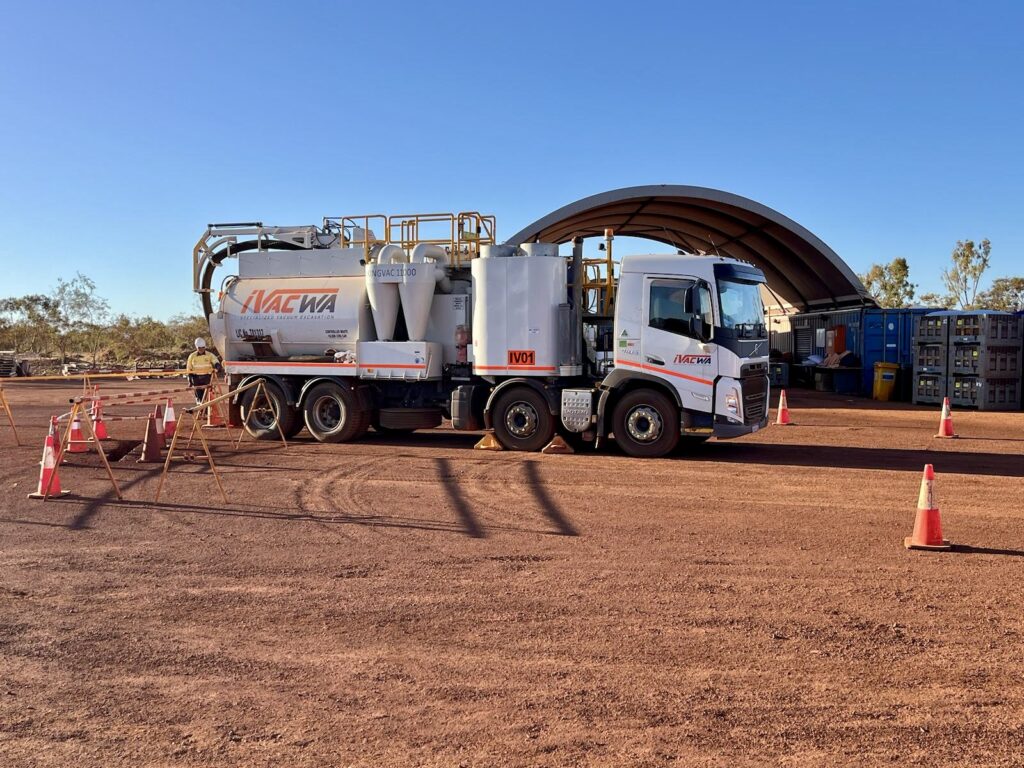
We support Western Australia’s mining sector with mine-spec vacuum excavation, hydro excavation, and liquid waste services built for remote and high-risk environments. Our fleet and trained personnel are trusted by leading mining companies to deliver safe, efficient, compliant outcomes across complex worksites.
Mining clients choose us because our offer is built for the sector rather than adapted to it:
- Experienced operators inducted for major mining clients, including Tier 1 inductions
- Mine-spec trucks with 10,000-litre spoil tanks and 4,000-litre water capacity
- Versatile capability across liquid, sludge, slurry, and fine materials
- Proven performance across remote sites throughout WA
- 24/7 emergency response for spills and contamination incidents
- Licensed controlled waste handling and disposal
- A strong focus on safety, reliability, and environmental compliance
- Servicing the Pilbara, Goldfields, Mid West, and all major WA mining regions
|
Need a mine-ready crew on site? Call (08) 6205 9986 or email info@ivacwa.com.au for a free estimate. |
Frequently Asked Questions
Why use vacuum excavation instead of a standard excavator on a mine site?
A mechanical excavator cuts through the ground with force, creating a real risk of striking buried power, communications, or dewatering infrastructure. Vacuum excavation loosens the ground gently and lifts it away, so assets are exposed safely. On a mine site, where a strike can halt production, that difference is significant.
Can vacuum trucks handle mine slurry and sludge?
Yes. High-capacity vacuum trucks are designed to extract slurry, thick sludge, fines, and ore dust from sumps, settling pits, conveyors, and processing areas, faster than manual clean-up and without putting crews into hazardous areas.
Do iVac WA crews meet mine site induction requirements?
Yes. Our operators are highly trained and fully inducted for work on mine sites across WA, including BHP, Rio Tinto, FMG, and other Tier 1 inductions, along with confined space and high-risk work certifications. Our crews work to daily Job Hazard Analyses and mine-specific safety protocols.
Which WA mining regions does iVac WA service?
We service the Pilbara, Goldfields, Mid West, and all major WA mining regions, with mine-spec trucks built for remote and rugged terrain.
Is vacuum excavation available for emergency spill response?
Yes. We offer 24/7 rapid response for slurry and chemical spill containment, waste extraction from bunded areas, environmental clean-up, and the disposal of hazardous liquid waste. Controlled waste is handled under licence, in line with regulatory requirements and each mine’s own environmental guidelines.
Conclusion
Vacuum excavation has become essential to how Western Australian mines manage underground infrastructure, heavy material, and environmental risk. It exposes buried assets without the danger of a mechanical strike, clears slurry and spillage faster and more safely than manual methods, and provides the rapid response that keeps a small incident from becoming a major one.
The deciding factor is the contractor. Mine-spec equipment, inducted and self-sufficient crews, versatile capability, and a real commitment to safety and environmental compliance are what separate an operator who can genuinely work on a mine from one who cannot.
We bring all of this together, with mine-spec trucks, Tier 1 inducted operators, licensed waste handling, and proven performance across the Pilbara, Goldfields, Mid West, and every major WA mining region.
|
To discuss your mining site‘s requirements or arrange a free estimate, call (08) 6205 9986 or email info@ivacwa.com.au. |