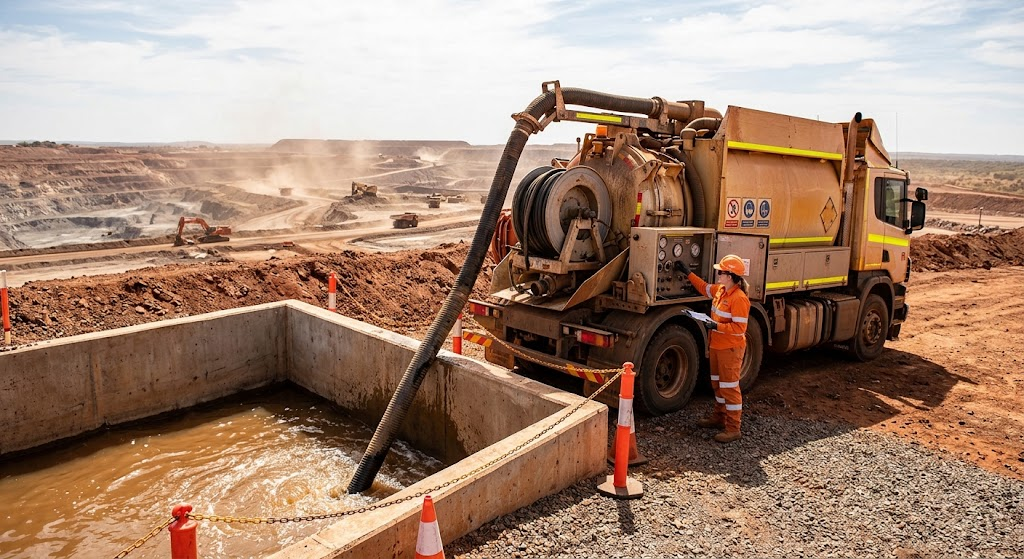
Western Australia’s mining sector runs on tight schedules and remote logistics, and waste does not wait for a convenient time to be dealt with. Sumps fill, wash bays back up, and drill spoil piles up faster than most sites can manage with a shovel and a truck tray. Mining vacuum trucks exist to solve exactly that problem, removing liquid and solid waste quickly, safely and without unnecessary handling, wherever a site needs it.
We operate the largest and most advanced vacuum truck fleet in Western Australia, and mining sites are one of the sectors we work with most.
Here is what mining vacuum trucks actually do, the waste streams they handle, and why they have become a standard part of how WA mine sites manage waste.
What Is a Mining Vacuum Truck?
A mining vacuum truck is a heavy-duty vacuum tanker built to remove liquid, sludge or solid material from a site using suction rather than manual digging or pumping. A hose is fed into a sump, pit, tank or excavation, and a powerful vacuum system draws the material into a sealed tank on the back of the truck, ready to be transported and disposed of correctly.
The same core technology used on commercial and civil sites is built out for mining conditions, with higher capacity tanks, more robust hoses and fittings, and trucks capable of working on unsealed roads and remote sites where a standard service vehicle would struggle.
Some trucks use water to help break down and flush material, known as hydro excavation, while others use vacuum alone to lift dry spoil, known as air excavation. Many mine sites need both, depending on the job.
Why Mine Sites Rely on Vacuum Trucks
Mining generates waste at a scale and pace that most other industries do not, and vacuum trucks are suited to nearly all of it.
Process water and sludge accumulate in sumps and settling ponds and need regular removal to keep operations running. Drill spoils and cuttings build up around exploration and drilling activity and have to be cleared to keep the site safe and workable.
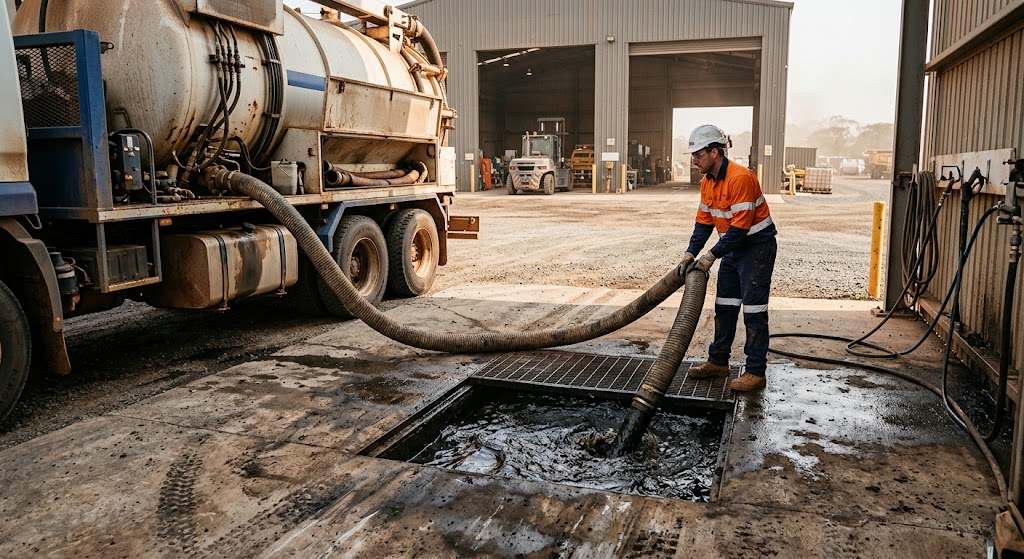
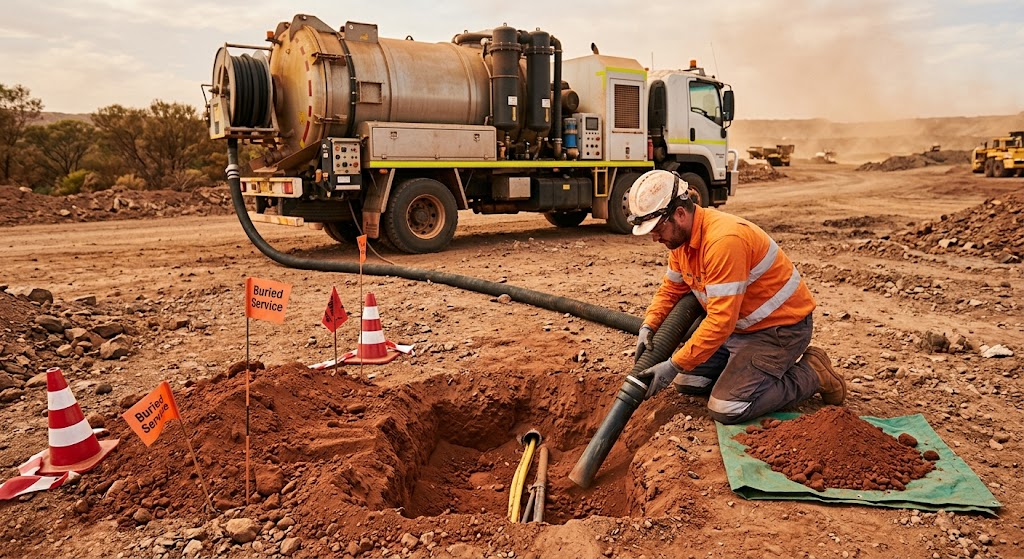
Wash bays and workshop pits, used to clean mobile plants and vehicles, fill with hydrocarbon-laden water that cannot simply be left or tipped out. And non-destructive digging is routinely used to expose buried services and infrastructure on-site without the risk of striking them with an excavator.
A vacuum truck handles all of these without anyone having to shovel, pump or manually decant the material, which matters on a site where safety around plants, pits and confined spaces is a constant consideration.
The Waste Streams Mining Vacuum Trucks Handle
Different waste types on a mine site call for slightly different handling, and an experienced operator adjusts the approach to suit each one.
| Waste type | Where it comes from | How it is removed |
| Process water and sludge | Sumps and settling ponds | Vacuum recovery, hydro excavation for thicker sludge |
| Drill spoil and cuttings | Exploration and drilling activity | Vacuum or air excavation |
| Wash bay and workshop water | Vehicle and plant wash-down | Vacuum recovery from bunded pits |
| Contaminated soil | Non-destructive digging around services | Vacuum excavation |
| General site sumps | Stormwater and runoff collection points | High-capacity vacuum pumping |
How a Vacuum Truck Service Works on a Mine Site
Every mine site job follows a similar sequence, adjusted for the site’s own procedures and access requirements.
We Confirm the Job and Site Requirements
Before mobilising, we confirm what needs to be removed, where it is, and any site-specific inductions, permits or access arrangements the mine requires. Remote sites in particular need this planned in advance so the truck arrives ready to work.
We Remove the Waste With Vacuum Recovery
The truck’s hose is positioned at the sump, pit or excavation, and the material is drawn into the sealed tank. For thicker sludge or compacted material, water assists the process, while dry spoil can often be lifted with suction alone. This keeps the waste contained from the moment it leaves the ground.
We Transport and Dispose of It Correctly
Once collected, the waste is transported off-site and disposed of at an appropriate facility, with different waste types, particularly anything contaminated or hazardous, directed to the right disposal pathway rather than treated as general waste.
Safety on Mine Sites
Safety is not optional on a Western Australian mine site, and it shapes how vacuum truck work is carried out. Operators need to be inducted to the site, follow its specific procedures around plant, traffic management and confined spaces, and work to the standards set out under WA’s mine site safety framework. WorkSafe WA publishes the codes of practice and guidance that govern safety on mining and exploration sites across the state, and vacuum truck work is planned around those requirements rather than around convenience.
Vacuum recovery itself is inherently safer than manual handling for a lot of mine site waste, since the operator controls the hose and truck from a distance rather than working inside a pit, sump or excavation.
Why This Matters for WA’s Mining Sector
Western Australia’s resources sector is enormous, and it underpins a large share of the state’s economy and employment. Sites operate around the clock, often in remote locations, and a delay in clearing a sump or a wash bay can hold up other work on-site. Reliable, on-call vacuum truck capacity is part of what keeps a mine site’s day-to-day operations moving, not just an occasional service.
Why Choose iVac WA
Mining sites need a vacuum truck service that turns up on time, understands site requirements, and handles the waste correctly. Here is what we bring to every job:
- We operate the largest and most advanced vacuum truck fleet in Western Australia, giving us the capacity for large volumes and remote site work.
- We remove process water, drill spoil, wash bay water and contaminated soil using vacuum and hydro excavation, suited to the material involved.
- We transport waste to the right disposal facility, keeping contaminated and hazardous streams properly separated.
- We work to mine site induction, access and safety requirements as standard.
- We support Western Australia’s mining, industrial, civil and commercial sectors, with a focus on safe work and a fast turnaround.
| Need a vacuum truck on your mine site or exploration project? Call iVac WA on (08) 6205 9986 or email info@ivacwa.com.au to arrange service. |
Frequently Asked Questions
What is a mining vacuum truck used for?
It removes liquid and solid waste from a mine site, including process water and sludge from sumps, drill spoil, wash bay water, and contaminated soil exposed during non-destructive digging, drawing it into a sealed tank for transport and disposal.
What is the difference between hydro and air excavation on a mine site?
Hydro excavation uses water to help break down and flush material before it is vacuumed up, which suits thicker sludge and compacted ground. Air excavation uses vacuum suction alone to lift drier material, which is often preferred where water use needs to be minimised.
Can vacuum trucks work on remote WA mine sites?
Yes. Mining vacuum trucks are built for site conditions, including unsealed roads and remote locations, and jobs are planned around each site’s access, induction and permit requirements in advance.
How often do mine site sumps need to be cleared?
It depends on the site and the volume of water or sludge generated, but sumps, settling ponds and wash bay pits are typically cleared on a regular schedule to prevent overflow and keep operations running smoothly, rather than waiting until they are full.
Is vacuum removal safer than manual digging or pumping on a mine site?
Yes. Vacuum recovery is operated from outside the pit, sump or excavation, which reduces the need for workers to enter confined spaces or handle waste directly, an important consideration under WA’s mine site safety requirements.
Do you handle hazardous or contaminated waste on mine sites?
Yes. Contaminated soil, hydrocarbon-laden wash water and similar waste streams are collected using vacuum recovery and transported to a facility licensed to accept that particular waste type, keeping it separated from general waste.
Conclusion
Mining vacuum trucks have become a standard part of how Western Australian mine sites manage waste, because they clear sumps, drill spoil, wash bay water and contaminated soil quickly, safely and without unnecessary manual handling.
On a site where schedules are tight and safety requirements are strict, reliability matters as much as the equipment itself.
Whether it is a single sump that needs clearing or an ongoing waste removal arrangement across a site, the right vacuum truck service keeps operations moving.
| To arrange a mining vacuum truck service in Western Australia, call iVac WA on (08) 6205 9986 or email info@ivacwa.com.au. |