Vacuum excavation is now the standard way to dig safely around underground infrastructure in Perth.
Instead of swinging a mechanical bucket near live power, gas, water, and communications assets, vacuum excavation loosens soil gently and lifts it away through a powerful suction hose. The result is a precise, low-risk dig that protects both the crew and the assets below ground.
What many site managers and civil contractors do not always realise is that vacuum excavation is not one method. There are two, wet and dry, and each suits different soil types, depths, and project goals.
Pick the wrong one and you face a slower dig, higher disposal costs, or unnecessary backfill. Pick the right one and the job stays on schedule and on budget.
This guide explains how each method works and how to choose the approach that suits your site.
What Is Vacuum Excavation?
Vacuum excavation, also called non-destructive digging (NDD), removes soil without the impact risk of a mechanical bucket. A specialised vacuum truck generates powerful suction that lifts loosened soil and spoils into a sealed onboard tank.
Because the ground is loosened gently rather than cut with steel, it is the preferred method for working near buried services. Common applications include utility potholing, trenching for new pipe or cable, slot trenching in built-up areas, excavating around tree roots, and installing poles or footings near existing services.
The two variations, wet and dry, differ only in how the soil is loosened before the vacuum lifts it. Everything after that step is broadly the same.
How Wet Vacuum Excavation Works
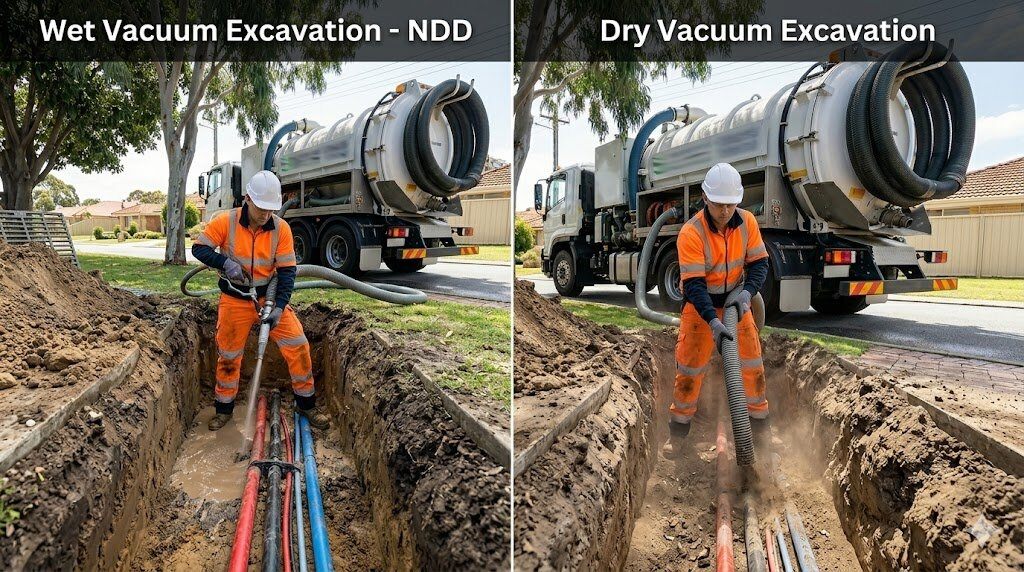
Wet vacuum excavation, often called hydro excavation, uses high-pressure water to break up soil.
An operator directs a focused water jet at the ground. The jet cuts into the soil and turns it into a slurry, and the vacuum system lifts that slurry into the truck’s debris tank.
The defining feature of wet excavation is cutting power. Pressurised water slices through compacted, hard, or clay-heavy ground far more effectively than air.
Strengths
- Cuts through compacted clay, stiff soils, and hard ground efficiently
- Holds performance at greater excavation depths
- Generally faster than dry excavation in difficult ground
- Water lubricates the system, reducing wear on hoses and components
Limitations
- Produces a wet slurry that cannot be reused as backfill
- Slurry must be carted off-site and disposed of, adding cost
- Needs a water supply and periodic tank refills
- Clean fill usually has to be imported to backfill the hole
Wet excavation is a strong all-rounder, especially where the ground is unknown or variable, because water cuts reliably through almost anything it meets.
How Dry Vacuum Excavation Works
Dry vacuum excavation, also called air excavation, uses high-pressure compressed air instead of water.
An operator directs an air lance at the ground. The compressed air agitates and loosens the soil, and the vacuum lifts the dry material into the debris tank.
The defining feature of dry excavation is that the spoil stays dry. Because no water is introduced, the material can often be returned straight to the hole as backfill once works are finished.
Strengths
- Spoil stays dry and can usually be reused on-site as backfill
- No slurry disposal costs and no need to import clean fill
- No water supply or refilling required, which cuts downtime
- Air is non-conductive, an advantage when exposing electrical assets
- Avoids the risk of water-related chemical reactions in some ground
Limitations
- Less effective in heavily compacted clay or very hard ground
- Generally slower than wet excavation in difficult material
- Best suited to shallower digs
- Can produce a sandblasting effect that needs careful operator control near services
In loose, free-draining soils, the kind found across much of Perth, dry excavation is fast, clean, and cost-effective.
Wet vs Dry Vacuum Excavation: Side-by-Side Comparison
| Factor | Wet Vacuum Excavation | Dry Vacuum Excavation |
| Loosening method | High-pressure water | High-pressure compressed air |
| Best soil type | Compacted clay, hard or stiff ground | Sand, loose and free-draining soils |
| Excavation depth | Performs well at greater depths | Best for shallower digs |
| Spoil condition | Wet slurry | Dry, reusable material |
| Backfill | Imported clean fill usually needed | Excavated spoil often reused on-site |
| Disposal cost | Higher, slurry must be removed | Lower, less material leaves site |
| Water supply | Required, with refills | Not required |
| Speed in hard ground | Faster | Slower |
| Near electrical assets | Safe, but water is conductive | Air is non-conductive |
Neither method wins outright. The right choice depends on the site, the soil, and the goal of the excavation.
Perth Geology: Why Method Selection Really Matters Here
Perth sits on the Swan Coastal Plain, and its ground conditions are not uniform. The plain is made up of distinct dune systems, and knowing which one your site sits on points strongly to the right method.
The Bassendean and Spearwood dune systems cover much of the metropolitan area with deep, leached quartz sand. On these soils, dry excavation is fast and clean, and the spoil is ideal for on-site reuse. The Quindalup dunes closer to the coast carry younger, carbonate-rich sands that also suit dry methods in most cases.
Move east toward the Darling Scarp and onto the Pinjarra Plain, and clay content rises sharply. Compacted clay resists air loosening, so wet excavation becomes the more efficient choice.
Site history matters just as much as geology. Heavily compacted hardstand on civil, mining, and industrial sites can resist air loosening regardless of the natural soil beneath. This is exactly why a single fixed method rarely fits every job in Perth.
Which Method Suits Your Site?
The decision usually comes down to a few practical questions.
Choose Dry Vacuum Excavation When
The ground is sandy or loose. Across the Bassendean and Spearwood sands, compressed air loosens material easily and the dig is fast.
Spoil will be reused as backfill. Where the excavated material suits backfilling, dry excavation avoids both disposal costs and the cost of importing clean fill.
You are exposing electrical assets. Air is non-conductive, which adds reassurance when potholing around live cables and conduits.
Water access or disposal is a constraint. On remote or regional WA sites, dry excavation reduces logistics and downtime.
Choose Wet Vacuum Excavation When
The ground is compacted clay or hard. On Pinjarra Plain clay or heavily compacted hardstand, pressurised water cuts through far more efficiently.
The dig is deep. Wet excavation holds performance at depth, where dry methods can slow down.
Speed through tough ground is critical. When the schedule is tight and the soil is difficult, the cutting power of water keeps the project moving.
Ground conditions are unknown. Water cuts reliably through a wide range of materials, making wet excavation a safe default when the soil profile is uncertain.
When Both Are Needed
On many Perth sites, conditions vary across a single job, sandy at the surface, clay-influenced lower down, or compacted in patches. The most capable contractors run a fleet that covers both, and switch as the ground demands. That flexibility removes the risk of locking in a method before the soil has had its say.
Matching Equipment to the Method
The right truck matters as much as the right method. iVac WA runs a varied fleet so the equipment can be matched to the ground and the access:
- KingVac 11000, for deep excavation and high-volume handling of both solid and liquid material
- Vacvator TMC76-245B, ideal for fine, heavy powders in urban environments with tight access
- Vac Dig, built for precision potholing in confined or high-risk environments
- Mudvac, ideal for liquid and sludge excavation on infrastructure projects
- STG Combo, a dual-function jetting and excavation unit suited to stormwater work
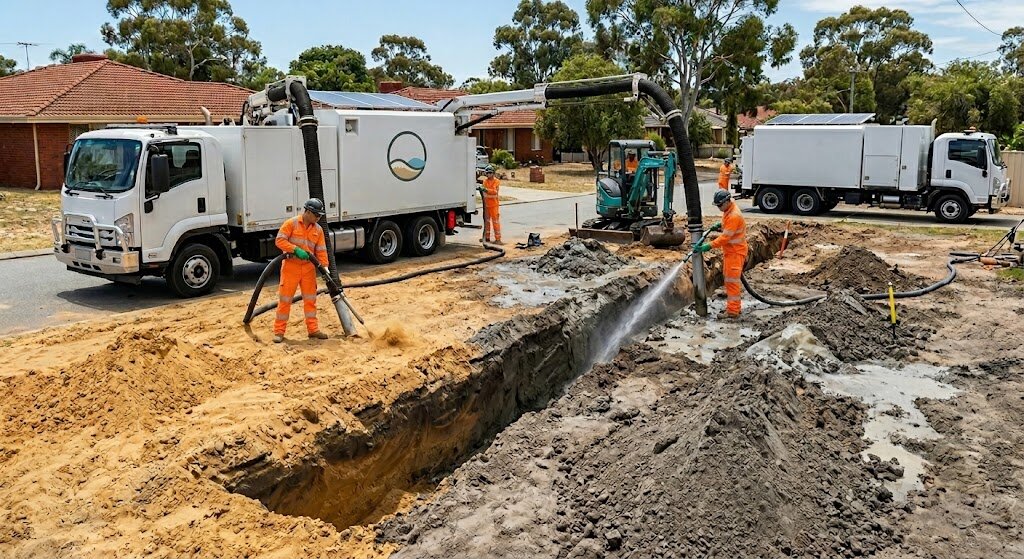
A practical example shows how this plays out. iVac WA recently completed a vacuum excavation project for MGC Civil at Secret Harbour, safely exposing underground assets ahead of trenching.
The team used the KingVac 11000 to complete the works without damaging existing infrastructure and within a tight project timeline. That is method selection in practice, the right machine, matched to the ground, delivering a clean result on schedule.
Safety, Compliance, and Disposal in WA
Method choice is not only about speed. It intersects with safety and compliance too. Vacuum excavation is the recommended approach for working near buried services because it greatly reduces the risk of striking an asset. The Dial Before You Dig process is the starting point, but plans alone do not confirm exact asset locations.
Non-destructive potholing is what physically verifies them. Safe excavation around utilities is also reinforced by guidance from WorkSafe in Western Australia, where the focus is on eliminating any risk of contact with live infrastructure.
Disposal is the other consideration. Wet excavation produces slurry that must be transported and handled appropriately, with requirements that vary depending on the material and any contamination. The Department of Water and Environmental Regulation sets the broader framework for waste handling in WA. Dry excavation, by keeping spoil reusable, often removes this part of the job entirely.
Why Choose iVac WA for Vacuum Excavation in Perth
Choosing the right vacuum excavation partner comes down to fleet capability, experience, and the judgement to match the method to the site. iVac WA delivers on all three:
- Perth’s largest and most advanced vacuum truck fleet in Western Australia
- Wet and dry capability, with the flexibility to switch as ground conditions demand
- Non-destructive digging specialists focused on safe work around live utilities
- Safe digging up to 3 metres or more, depending on ground conditions
- Underground utility locating and exposure delivered alongside excavation
- Experienced across mining, civil construction, commercial, and government and defence sectors
- Fast turnaround, servicing Perth metro and regional WA, with free estimates
Because the same team also delivers stormwater drain cleaning, jetting and pipe unblocking, and emergency response, multi-service projects are handled without juggling separate contractors.
|
To discuss your project or arrange a free estimate for vacuum excavation in Perth, call (08) 6205 9986 or email info@ivacwa.com.au. |
Frequently Asked Questions
Is wet or dry vacuum excavation safer?
Both are far safer than mechanical excavation near buried services, because soil is loosened gently rather than cut with a steel bucket. Dry excavation has a specific edge when exposing electrical assets, since air is non-conductive. The safest choice overall is a contractor who matches the method to the site and follows correct locating procedures.
Which method is faster?
It depends on the ground. In compacted clay or hard material, wet excavation is generally faster because water cuts through tough soil efficiently. In loose, sandy Perth soils, dry excavation is fast and clean.
Can excavated spoils be reused as backfill?
With dry vacuum excavation, usually yes, the spoil stays dry and can often be returned to the excavation. With wet excavation, the spoil becomes a slurry that usually cannot be reused, so clean fill is generally imported instead.
How deep can vacuum excavation dig?
Depending on ground conditions, iVac WA can safely excavate up to 3 metres or more. Wet excavation generally holds its performance better at greater depths.
What is the difference between vacuum excavation and hydro excavation?
Hydro excavation is one type of vacuum excavation, specifically the wet method using pressurised water. Dry vacuum excavation uses compressed air instead. Both rely on powerful suction to lift the loosened material into the truck.
Conclusion
Wet and dry vacuum excavation are not competitors. They are complementary tools.
Wet excavation brings cutting power for compacted clay, hard ground, and deeper digs.
Dry excavation brings clean, reusable spoil and lower disposal costs in Perth’s sandy soils. The best result on any site comes from matching the method to the ground and the project goals, rather than forcing one approach to fit every job.
iVac WA operates Perth’s largest and most advanced vacuum truck fleet, with full wet and dry capability and the experience to recommend the right method for your site. Whether the job is utility potholing in Bassendean sand, deep excavation through Pinjarra Plain clay, or a mixed civil project that needs both, the team delivers safe, precise, non-destructive results.
|
To discuss your project or arrange a free estimate for vacuum excavation in Perth, call (08) 6205 9986 or email info@ivacwa.com.au. |